Founded in 1938 and published semiannually by Sophia University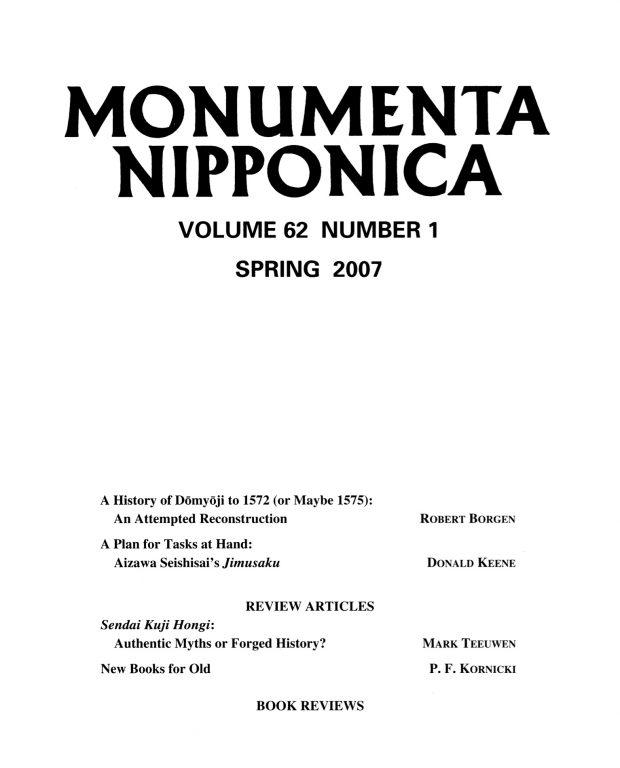 MN 62:1 (2007) 97–105New Books for OldPeter F. Kornicki
- MN 62:1 (2007) 107–109Japan’s Medieval Population: Famine, Fertility, and Warfare in a Transformative Age by William Wayne FarrisBruce L. Batten
- MN 62:1 (2007) 110–12The Dog Shogun: The Personality and Policies of Tokugawa Tsunayoshi by Beatrice M. Bodart-BaileyAnne Walthall
- MN 62:1 (2007) 113–15A Reader in Edo Period Travel by Herbert PlutschowLaura Nenzi
- MN 62:1 (2007) 115–19JAPANimals: History and Culture in Japan’s Animal Life ed. Gregory M. Pflugfelder, Brett L. WalkerHans Martin Krämer
- MN 62:1 (2007) 119–21Gendering Modern Japanese History ed. Barbara Moloney, Kathleen UnoAnne E. Imamura
- MN 62:1 (2007) 121–24Kamikaze Diaries: Reflections of Japanese Student Soldiers by Emiko Ohnuki-TierneyBarak Kushner
- MN 62:1 (2007) 124–27Localizing Paradise: Kumano Pilgrimage and the Religious Landscape of Premodern Japan by D. Max MoermanIyanaga Nobumi
- MN 62:1 (2007) 127–31Woman Critiqued: Translated Essays on Japanese Women’s Writing ed. Rebecca CopelandJudit Árokay
- MN 62:1 (2007) 131–34Representing the Other in Modern Japanese Literature: A Critical Approach ed. Rachael Hutchinson, Mark WilliamsJoseph S. O'Leary
- MN 62:1 (2007) 2007Monumenta Nipponica Volume 62, Number 1, 2007
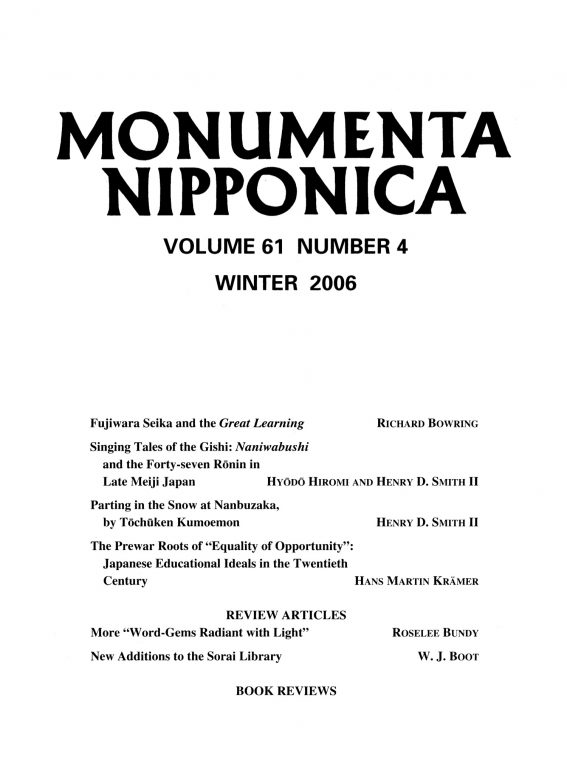 MN 61:4 (2006) 437–57Fujiwara Seika and the Great LearningRichard Bowring
- MN 61:4 (2006) 459–508Singing Tales of the Gishi: Naniwabushi and the Forty-seven Rōnin in Late Meiji JapanHenry D. Smith II and Hiromi Hyōdō
- MN 61:4 (2006) 509–519Parting in the Snow at NanbuzakaTōchūken Kumoemon, Translated by Henry D. Smith II
- MN 61:4 (2006) 521–549The Prewar Roots of “Equality of Opportunity”: Japanese Educational Ideals in the Twentieth CenturyHans Martin Krämer
- MN 61:4 (2006) 551–558More “Word-Gems Radiant with Light”Roselee Bundy
- MN 61:4 (2006) 559–566New Additions to the Sorai LibraryW. J. Boot
- MN 61:4 (2006) 567–569Women in Medieval Japan: Motherhood, Household Management and Sexuality by Wakita HarukoJanet R. Goodwin
- MN 61:4 (2006) 569–571Die “böse Alte” in der japanischen Populärkultur der Edo-Zeit: Die Feindvalenz und ihr soziales Umfeld by Susanne FormanekMartina Schönbein
- MN 61:4 (2006) 572–574Practical Pursuits: Takano Chōei, Takahashi Keisaku, and Western Medicine in Nineteenth-Century Japan by Ellen Gardner NakamuraAnn Bowman Jannetta
- MN 61:4 (2006) 574–576Lever of Empire: The International Gold Standard and the Crisis of Liberalism in Prewar Japan by Mark MetzlerSimon James Bytheway
- MN 61:4 (2006) 577–580Divisions of Labor: Globality, Ideology, and War in the Shaping of the Japanese Labor Movement by Lonny E. CarlileTom Gill
- MN 61:4 (2006) 580–582The Religious Traditions of Japan 500–1600 by Richard BowringJames L. Ford
- MN 61:4 (2006) 583–585Classical Japanese: A Grammar by Haruo ShiraneStephen D. Miller
- MN 61:4 (2006) 585–587Swords, Oaths, and Prophetic Visions: Authoring Warrior Rule in Medieval Japan by Elizabeth OylerRichard A. Gardner
- MN 61:4 (2006) 587–590Advertising Tower: Japanese Modernism and Modernity in the 1920s by William GardnerAlisa Freedman
- MN 61:4 (2006) 2006Monumenta Nipponica Volume 61, Number 4, 2006
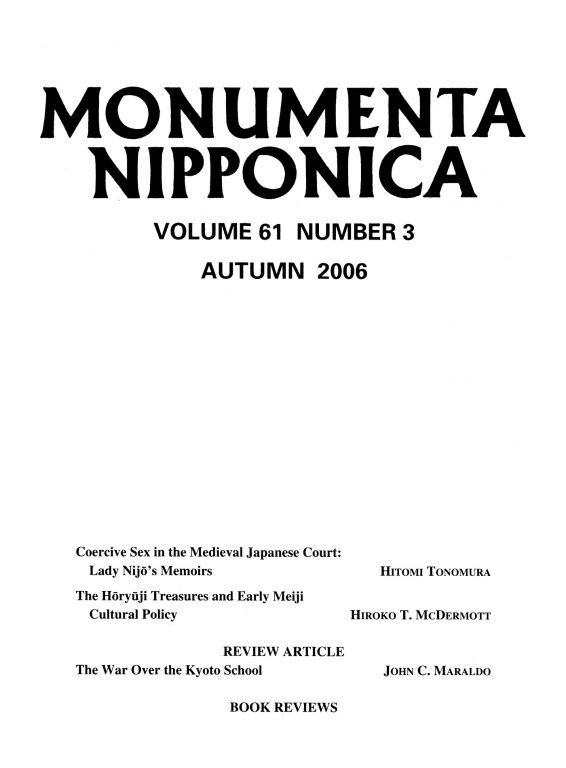 MN 61:3 (2006) 283–338Coercive Sex in the Medieval Japanese Court: Lady Nijō’s MemoirHitomi Tonomura
- MN 61:3 (2006) 339–74The Hōryūji Treasures and Early Meiji Cultural PolicyHiroko T. McDermott
- MN 61:3 (2006) 375–406The War Over the Kyoto SchoolJohn C. Maraldo
- MN 61:3 (2006) 407–409Le riz dans le culture de Heian, mythe et réalité by Charlotte von VerschuerRobert Borgen
- MN 61:3 (2006) 409–12Capital and Countryside in Japan, 300–1180: Japanese Historians Interpreted in English ed. Joan R. PiggottWilliam Wayne Farris
- MN 61:3 (2006) 412–16The Japanese Mission to Europe, 1582–1590: The Journey of Four Samurai Boys Through Portugal, Spain and Italy by Michael CooperAdriana Boscaro
- MN 61:3 (2006) 416–18The Development of the Japanese Nursing Profession: Adopting and Adapting Western Influences by Aya TakahashiSally Ann Hastings
- MN 61:3 (2006) 418–22Isami’s House: Three Centuries of a Japanese Family by Gail Lee BernsteinBrian W. Platt
- MN 61:3 (2006) 422–25Reasonable Men, Powerful Words: Political Culture and Expertise in Twentieth-Century Japan by Laura HeinSusan Townsend
- MN 61:3 (2006) 425–28Appraising Genji: Literary Criticism and Cultural Anxiety in the Age of the Last Samurai by Patrick W. CaddeauThomas J. Harper
- MN 61:3 (2006) 428–32Kannani and Document of Flames: Two Japanese Colonial Novels by Katsuei Yuasa, trans. Mark DriscollNobuko Miyama Ochner
- MN 61:3 (2006) 432–35Unspeakable Acts: The Avant-Garde Theatre of Terayama Shūji and Postwar Japan by Carol Fisher SorgenfreiDavid G. Goodman
- MN 61:3 (2006) 2006Monumenta Nipponica Volume 61, Number 3, 2006
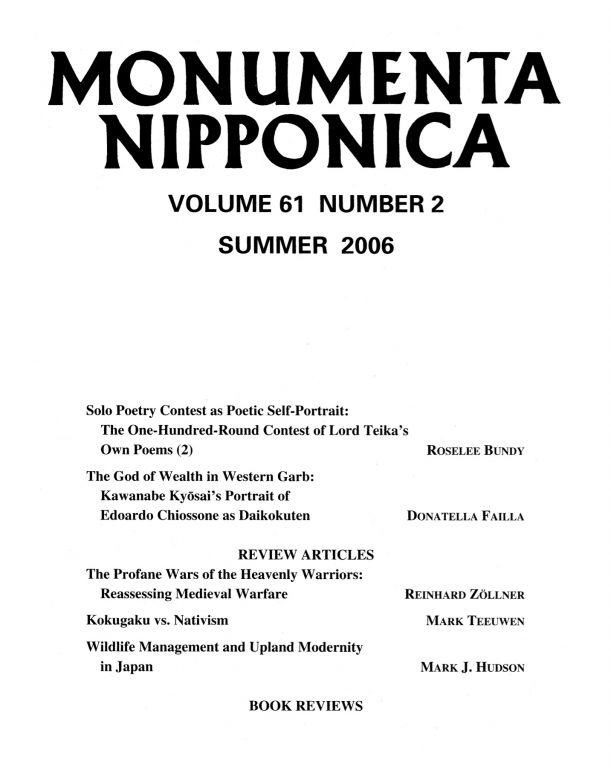 MN 61:2 (2006) 131–92Solo Poetry Contest as Poetic Self-Portrait: The One-Hundred-Round Contest of Lord Teika’s Own Poems (Part 2)Roselee Bundy
- MN 61:2 (2006) 193–218The God of Wealth in Western Garb: Kawanabe Kyōsai’s Portrait of Edoardo Chiossone as DaikokutenDonatella Failla
- MN 61:2 (2006) 219–26The Profane Wars of the Heavenly Warriors: Reassessing Medieval WarfareReinhard Zöllner
- MN 61:2 (2006) 227–42Kokugaku vs. NativismMark Teeuwen
- MN 61:2 (2006) 243–49Wildlife Management and Upland Modernity in JapanMark J. Hudson
- MN 61:2 (2006) 251–54Ambassadors from the Islands of Immortals: China-Japan Relations in the Han-Tang Period by Zhenping WangCharlotte von Verschuer
- MN 61:2 (2006) 254–56Negotiating with Imperialism: The Unequal Treaties and the Culture of Japanese Diplomacy by Michael R. AuslinM. William Steele
- MN 61:2 (2006) 257–60Rural Economic Development in Japan: From the Nineteenth Century to the Pacific War by Penelope FrancksKerry Smith