Founded in 1938 and published semiannually by Sophia University MN 37:3 (1982) 289–316The Kaneko Correspondence (Part 3)Kaneko Kentarō, Edited by James Kanda and William A. Gifford
 MN 37:2 (1982) 223–56The Kaneko Correspondence (Part 2)Kaneko Kentarō, Edited by James Kanda and William A. Gifford
 MN 37:1 (1982) 55–76The Kaneko Correspondence (Part 1) (Translation)Kaneko Kentarō, Edited by James Kanda and William A. Gifford
- MN 37:1 (1982) 41–76The Kaneko Correspondence (Part 1)James Kanda and William A. Gifford
 MN 36:4 (1981) 391–423The Yamagata-Tokutomi Correspondence: Press and Politics in Meiji-Taishō JapanGeorge Akita and Takashi Itō
 Monographs (1981) 1–171The Laws of the Muromachi Bakufu: Kemmu Shikimoku (1336) and Muromachi Bakufu TsuikahōEdited by Kenneth A. Grossberg, Translated by Kenneth A. Grossberg and Nobuhisa Kanamoto
 MN 36:3 (1981) 299–316Against the Restoration: Katsu Kaishū’s Attempt to Reinstate the Tokugawa FamilyM. William Steele
 MN 36:2 (1981) 173–86Apologia pro Vita Sua: Arai Hakuseki’s AutobiographyKate Wildman-Nakai
- MN 36:2 (1981) 187–93Public Official or Feudal Lord?Mary Elizabeth Berry
 MN 35:4 (1980) 405–35Sata Mirensho: A Fourteenth-Century Law PrimerTranslated by Carl Steenstrup
 MN 34:4 (1979) 467–78Councillor Defended: Matsukage Nikki and Yanagisawa YoshiyasuBeatrice Bodart-Bailey
 MN 34:1 (1979) 63–72Ōdōron (The Way of the King)Chiba Takusaburō , Translated by Richard Devine
- MN 34:1 (1979) 49–72The Way of the King: An Early Meiji Essay on GovernmentRichard Devine
- MN 34:1 (1979) 73–99Ōyama Estate and Insei Land PoliciesElizabeth Sato
 MN 33:4 (1978) 379–405Methods of Land Transfer in Medieval JapanJames Kanda
 MN 33:2 (1978) 151–64The Kansei Reforms—Success or Failure?Isao Soranaka
 MN 33:1 (1978) 37–50Opinion Revised: Hara Takashi’s Views on Local GovernmentRichard Staubitz
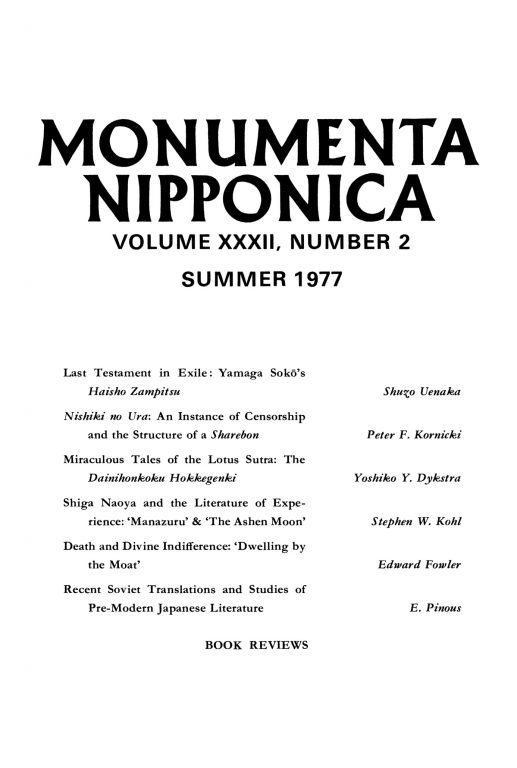 MN 32:2 (1977) 131–52Haisho ZampitsuYamaga Sokō, Translated by Shuzo Uenaka
- MN 32:2 (1977) 125–52Last Testament in Exile: Yamaga Sokō’s Haisho ZampitsuShuzo Uenaka
- MN 32:2 (1977) 167–88A Brothel in the Light of Day: The Other Side of the BrocadeSantō Kyōden, Translated by Peter F. Kornicki
- MN 32:2 (1977) 153–88Nishiki no Ura: An Instance of Censorship and the Structure of a SharebonPeter F. Kornicki
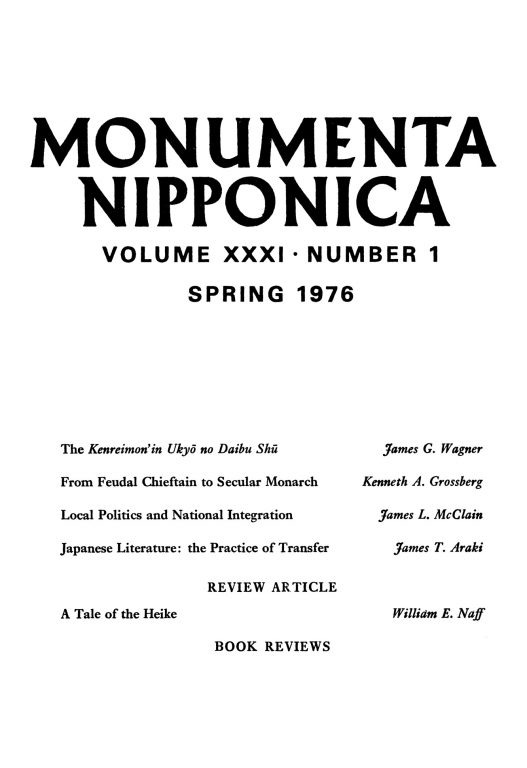 MN 31:1 (1976) 29–49From Feudal Chieftain to Secular Monarch: The Development of Shogunal Power in Early Muromachi JapanKenneth A. Grossberg
- MN 31:1 (1976) 51–75Local Politics and National Integration: The Fukui Prefectural Assembly in the 1880sJames L. McClain
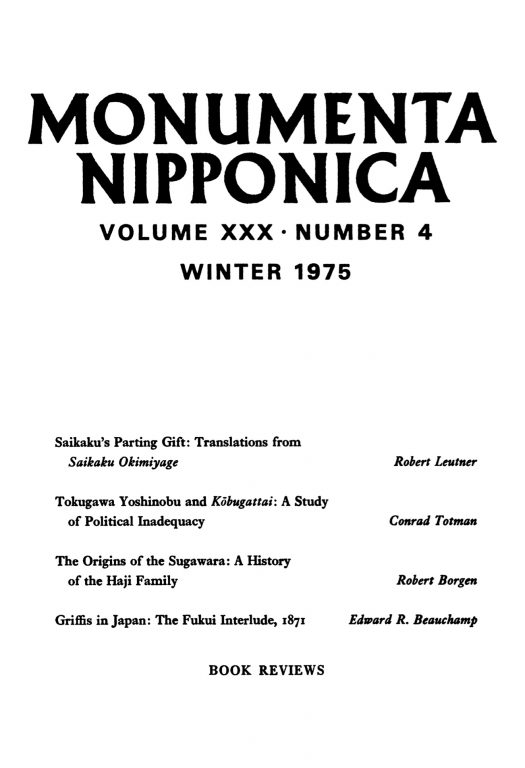 MN 30:4 (1975) 393–403Tokugawa Yoshinobu and Kōbugattai: A Study of Political InadequacyConrad Totman
 MN 29:4 (1974) 451–75Japan’s Young Prince: Konoe Fumimaro’s Early Political Career, 1916–1931Gordon Mark Berger
 MN 28:3 (1973) 317–45Japan’s Peace Preservation Law of 1925: Its Origins and SignificanceRichard H. Mitchell
 MN 28:2 (1973) 151–75Nishi Amane and the Reception of Western Law in JapanRichard H. Minear
 MN 27:2 (1972) 125–42The Hara Cabinet and Chang Tso-lin, 1920–1John W. Young
 MN 26:3/4 (1971) 330–93KinjiseironkōKuga Katsunan, Translated by Barbara J. Teters
- MN 26:3/4 (1971) 319–93Kinjiseironkō: Thoughts on Recent Political DiscourseBarbara J. Teters
 Monographs (1970) 1–103The Evolution of the Concept of Matrimonial Consent in Japanese LawAugustinus Kōno Yoshisuke
 MN 25:1/2 (1970) 137–54Ono Azusa and the Political Change of 1881Sandra T. W. Davis
 MN 24:4 (1969) 353–71Early Meiji Liberalism: An AssessmentMikiso Hane
 MN 24:3 (1969) 259–72The Sources of English Liberal Concepts in Early Meiji JapanMikiso Hane
 MN 23:1/2 (1968) 156–86Kokuze sanron: The Three Major Problems of State Policy. Recorded in the 1st Year of Man’en (1860) at Fukui, Echizen ProvinceYokoi Shōnan, Translated by D. Y. Miyauchi
 MN 22:3/4 (1967) 390–401“Dual Sovereignty”: Under the Japanese Shogunate as Interpreted by French Writers of the Eighteenth CenturyJacques Bésineau, Translated by Patrick O'Flanagan
- MN 22:3/4 (1967) 402–36The Japanese Woman’s Movement: Ichikawa Fusae, A Pioneer in Woman’s SuffrageDee Ann Vavich
- MN 22:3/4 (1967) 468–81Discussion of Violent Revolution, From a Jail CellKōtoku Shūsui, Translated by George Elison
- MN 22:3/4 (1967) 437–81Kōtoku Shūsui: The Change in ThoughtGeorge Elison
 MN 22:1/2 (1967) 15–48The Challenge from Tradition: Attempts to Compile a Civil Code in Japan, 1866–78Robert Epp
- MN 22:1/2 (1967) 103–21Political Action & Trade Unions: A Case Study of the Coal Miners in JapanAlice H. Cook
- MN 22:1/2 (1967) 147–61The Political Cynicism of Law Students in JapanYasumasa Kuroda
 MN 20:3/4 (1965) 444–48Aspects of the National Character Reflected in Japanese Penal LawFumio Aoyagi
 MN 19:1/2 (1964) 44–65Commentaries on the Constitution of the Empire of Japan (Part 2)Hermann Roesler, Translated by Johannes Siemes
- MN 19:1/2 (1964) 37–65Hermann Roesler’s Commentaries on the Meiji Constitution (Part 2)Johannes Siemes
 MN 18:1/4 (1963) 191–235The Case of Baba Tatsui: Western Enlightenment, Social Change and the Early Meiji IntellectualEugene Soviak
 MN 17:1/4 (1962) 17–66Commentaries on the Constitution of the Empire of Japan (Part 1)Hermann Roesler, Translated by Johannes Siemes
- MN 17:1/4 (1962) 1–66Hermann Roesler’s Commentaries on the Meiji Constitution (Part 1)Johannes Siemes